Multi-Agent
& Social Intelligence.
Collaborative problem solving and behaviorally grounded simulation.
We study how agents coordinate models and tools to solve tasks, and how computational agents can represent human behavior in social environments.
Coordinate expertise.
Task organization, model collaboration, and feedback-driven optimization.
Understand collective behavior.
Spatially grounded individual behavior, population dynamics, and simulation reliability.
TrajAgent
TrajAgent: An LLM-Agent Framework for Trajectory Modeling via Large-and-Small Model Collaboration
NeurIPS 2025Coordinate models to solve trajectory tasks.
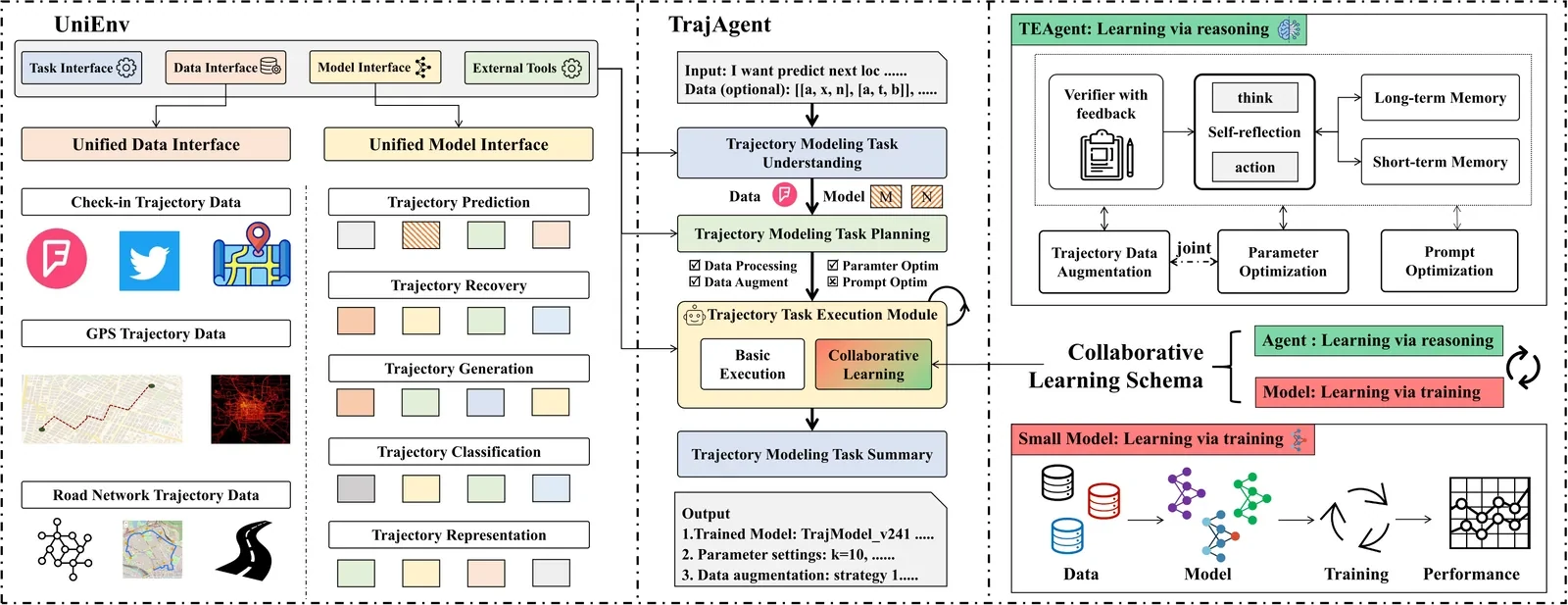
TrajAgent coordinates LLM-based agents with specialized models through a unified execution environment. Its workflow organizes task interpretation, model selection, execution, and result analysis.
Feedback guides subsequent optimization. The focus is task-oriented orchestration and large-and-small model collaboration.
AgentMove
AgentMove: A Large Language Model based Agentic Framework for Zero-shot Next Location Prediction
NAACL 2025Connect individual behavior with urban context.
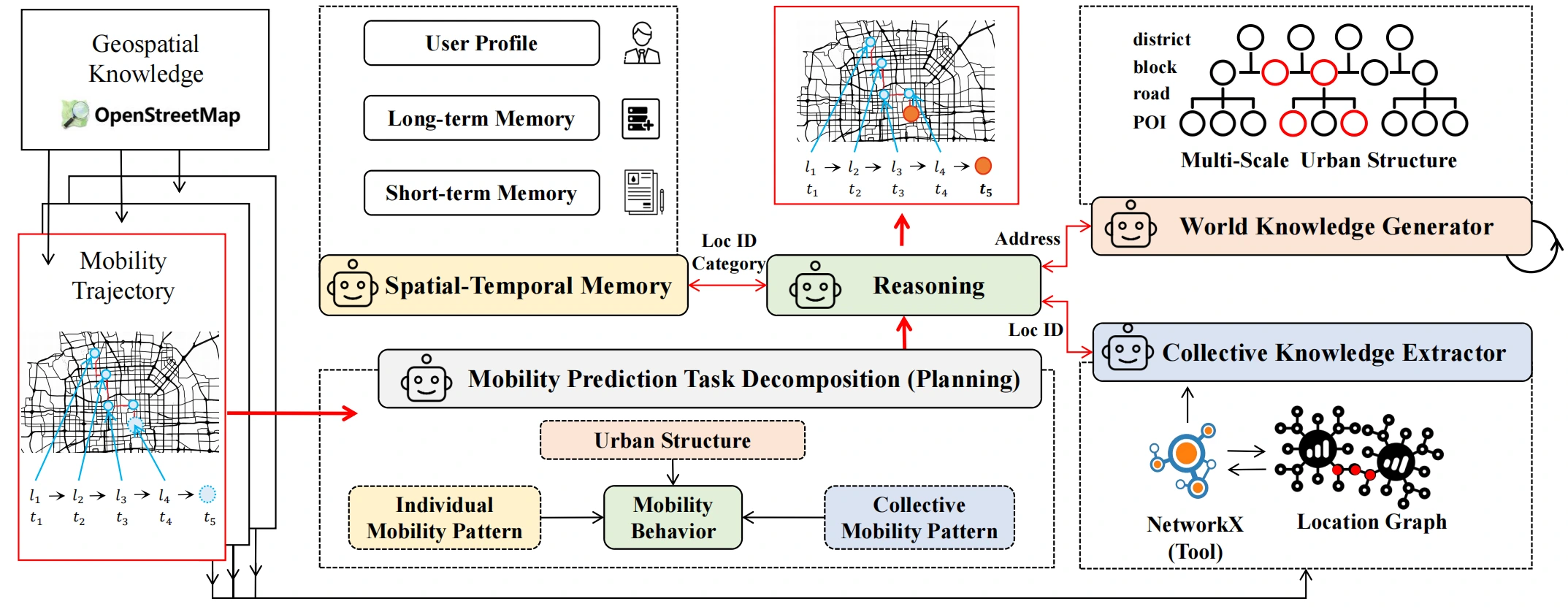
AgentMove combines individual mobility memory, urban spatial knowledge, and population-level mobility patterns to predict a person’s next location in a zero-shot setting.
Structured reasoning links individual behavior with collective regularities across cities.
GAMS
GAMS: Geospatial Knowledge Enhanced Agentic Framework for Urban Human Mobility Behavior Simulation
EMNLP 2026 FindingsConnect individual behavior with spatial context.
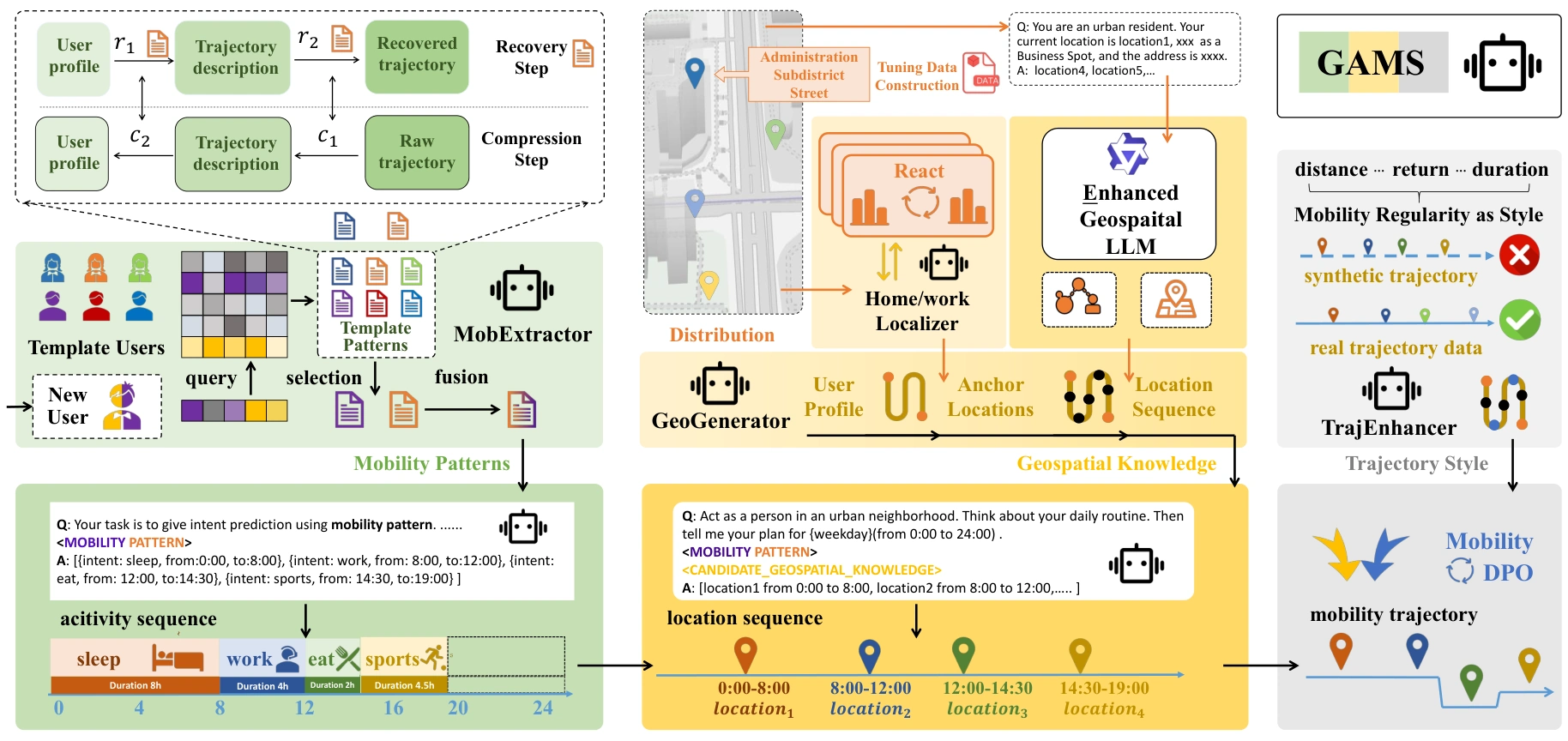
GAMS investigates how geospatial knowledge and human mobility patterns can inform agent-based behavior generation. It links individual behavioral preferences with urban spatial context and collective mobility constraints.
This research examines how spatial knowledge and behavioral evidence improve the realism of urban mobility simulation.
OpenCity
Designing A Scalable LLM Agent Framework for Large-scale Urban Segregation Simulation
KDD 2026 AI4SStudy urban segregation through individual activity.
OpenCity provides a scalable framework for examining urban segregation through LLM-based agent simulation. It supports investigation of how heterogeneous individual activities relate to collective spatial patterns.
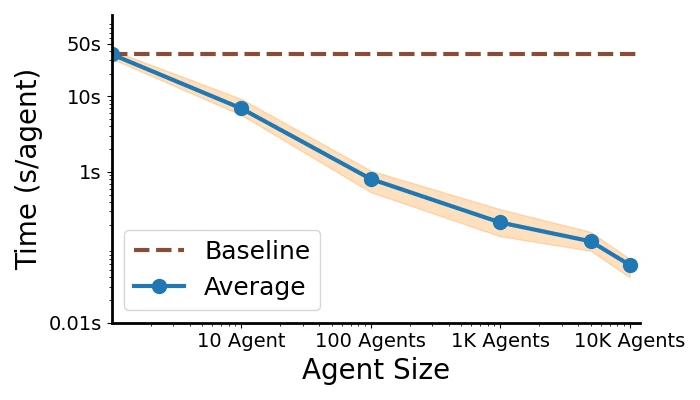
Larger populations become tractable while agent-specific dynamic information is retained. Explore the inference systems perspective

APS
APS: Bias-Controlled Adaptive Prototype Simulation for Population-Scale LLM Agents
NeurIPS 2026 OralPreserve variation under approximation.
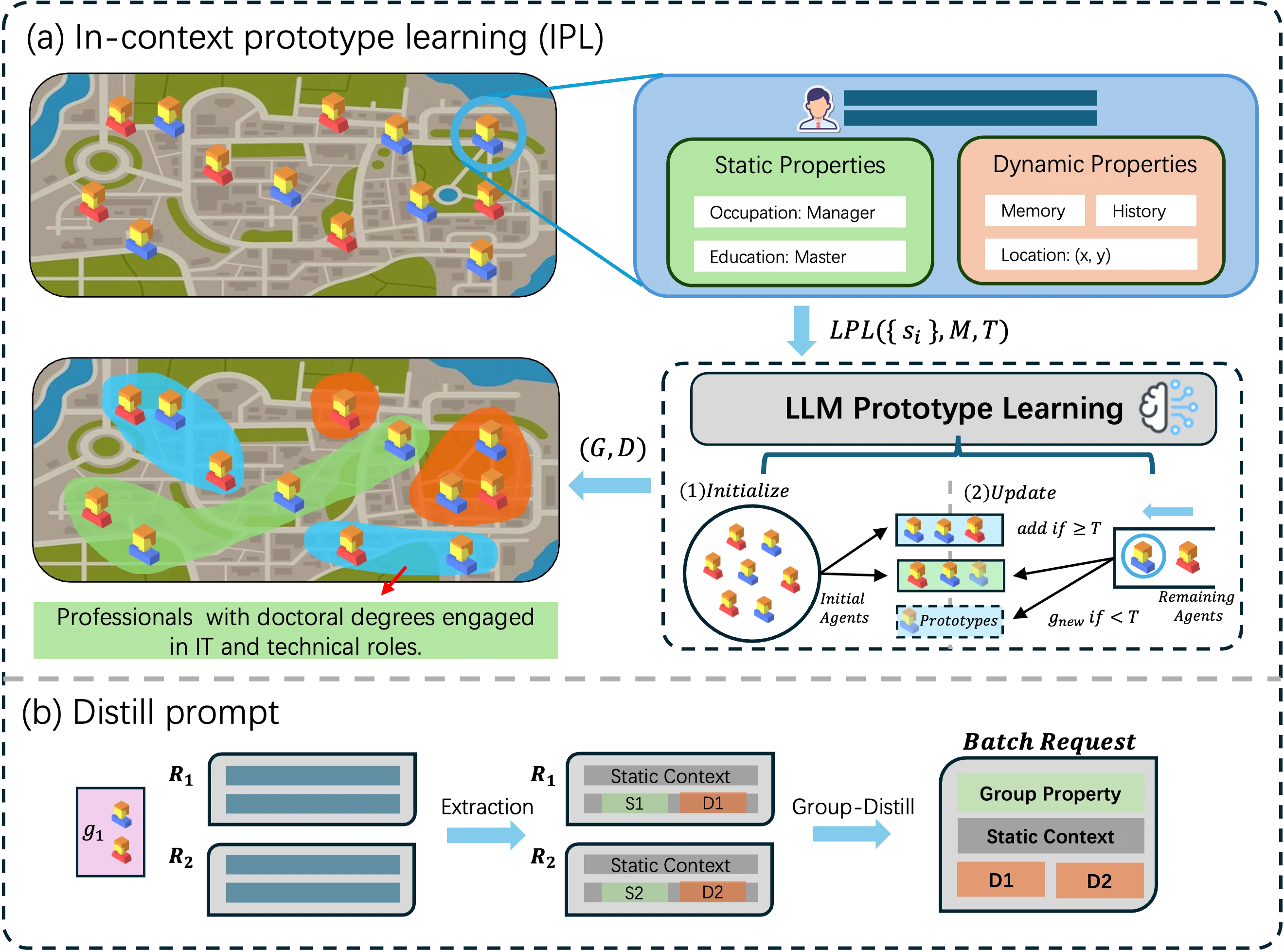
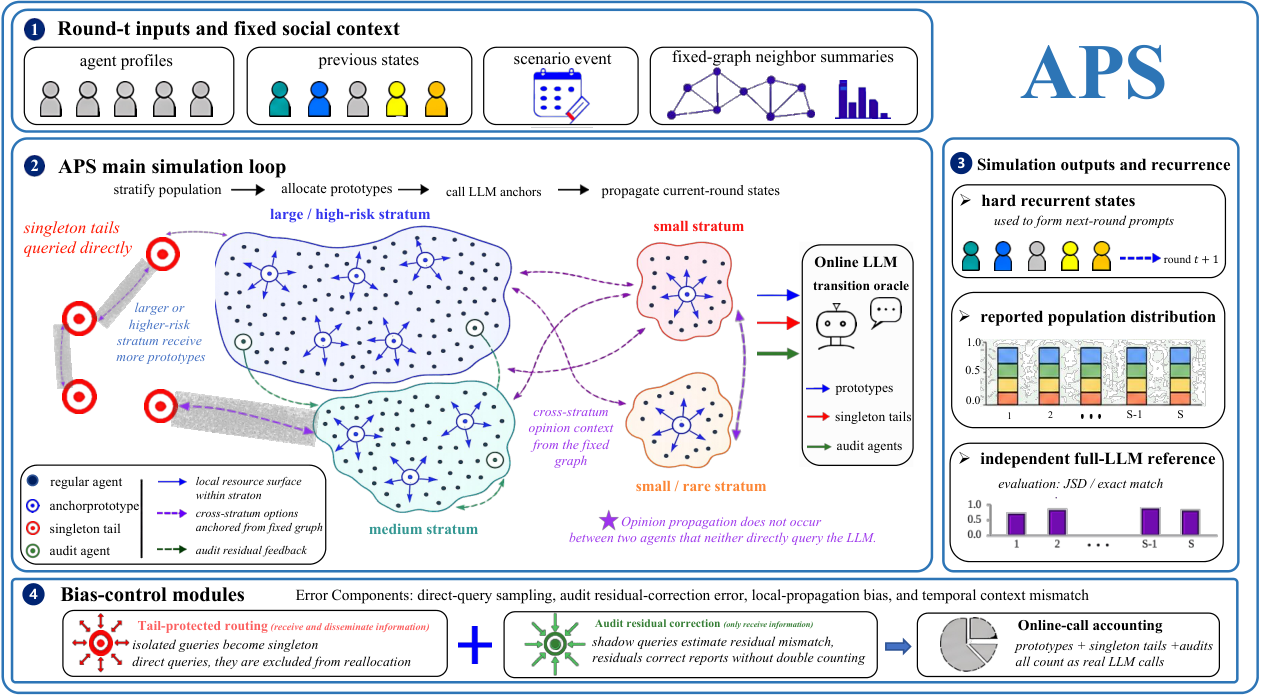
APS examines how population-scale simulations can remain informative when only a subset of agents receives direct LLM queries. Adaptive prototypes are combined with individual treatment of selected heterogeneous agents and shadow-audit correction.
The goal is to control deviations from full-LLM simulation while preserving important population variation. Agreement with this reference does not by itself establish fidelity to real human behavior.
Questions we are exploring next.
We are interested in coordination under changing tasks, heterogeneous agents, and dynamic environments. Evaluation should distinguish task success, behavioral plausibility, and the reliability of population-level conclusions.
Back to the research program